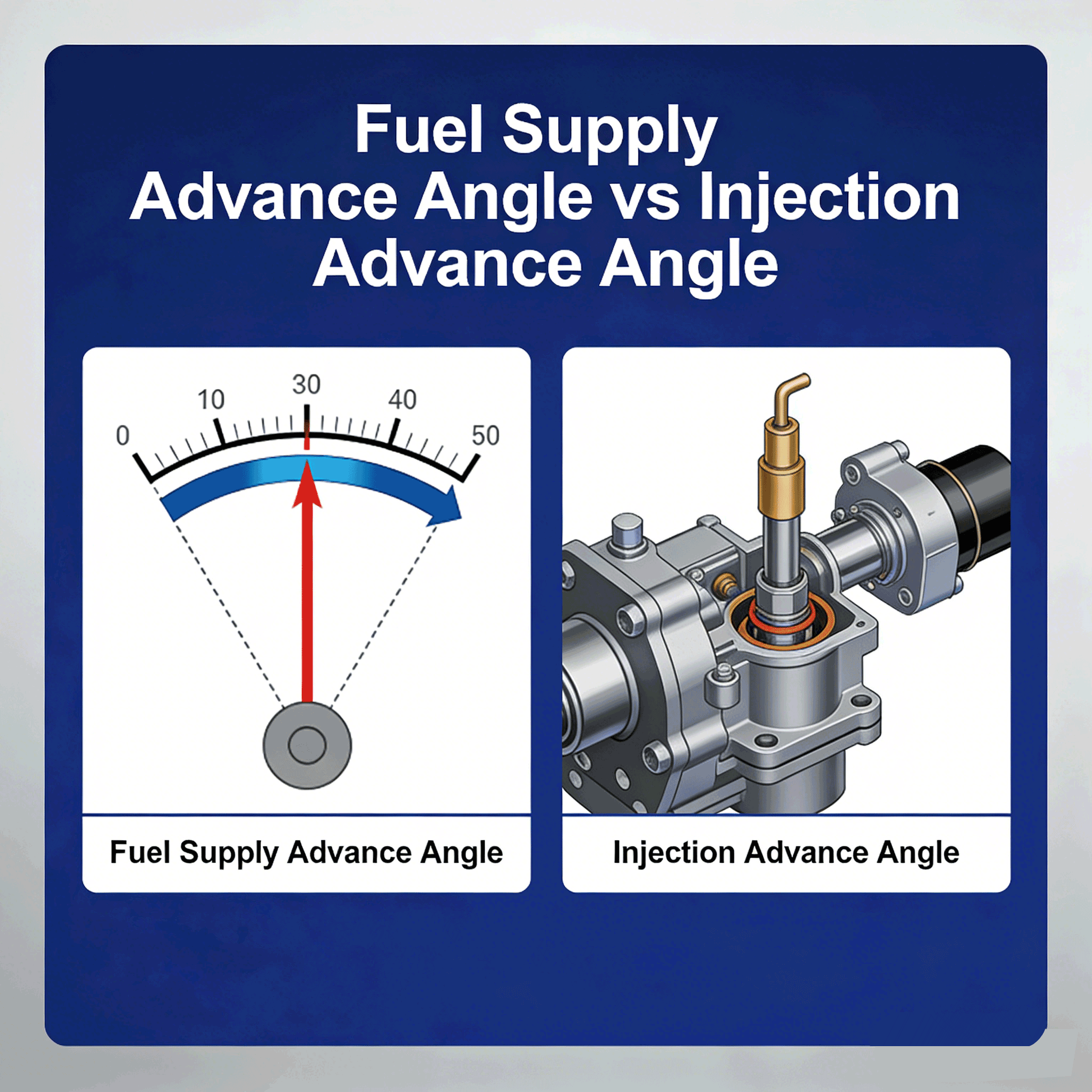
The fuel supply advance angle and the injection advance angle are two distinct technical concepts in the fuel injection system of diesel engines, with different numerical values and connotations, which must not be confused or used interchangeably.
From a scientific and rigorous perspective, the fuel supply advance angle is defined as the crankshaft angle between the position of the crankshaft in the first cylinder of the diesel engine at the moment when the plunger in the first cylinder of the fuel injection pump starts to deliver fuel (i.e., the plunger begins to compress fuel and push it into the high-pressure oil pipe) and the position when the piston in the first cylinder reaches the top dead center (TDC) of the compression stroke. In contrast, the injection advance angle refers to the crankshaft angle between the position of the crankshaft in the first cylinder of the diesel engine at the moment when the fuel injector in the first cylinder starts to inject atomized fuel into the combustion chamber and the position when the piston reaches the top dead center (TDC) of the compression stroke. It should be emphasized that both angles are measured relative to the top dead center of the piston in the compression stroke, which is the unified reference standard for their definition.
In the actual working process of the diesel engine, after the plunger of the fuel injection pump starts to supply fuel, the diesel fuel will undergo elastic volume contraction under high pressure (usually 10-20 MPa), and the high-pressure oil pipe will produce slight elastic expansion due to the action of high fuel pressure. At the same time, the high-pressure fuel forms a pressure wave that propagates from the fuel injection pump to the fuel injector, and this propagation process requires a certain amount of time (i.e., pressure wave propagation lag). Due to the combined effect of these three factors—fuel volume contraction, high-pressure oil pipe expansion, and pressure wave propagation lag—there is a certain time interval between the start of fuel supply by the fuel injection pump and the start of fuel injection by the fuel injector. Correspondingly, for the same diesel engine under the same operating conditions, the fuel supply advance angle is always larger than the injection advance angle, and the difference between the two (i.e., the injection lag angle) is generally about 8 crankshaft degrees, which may vary slightly according to the model of the diesel engine, the length of the high-pressure oil pipe, and the viscosity of the diesel fuel.
Both the fuel supply advance angle and the injection advance angle of the diesel engine need to be inspected on the engine body, but the inspection principles and methods are quite different due to their different characteristics.
The inspection of the fuel supply advance angle is carried out under the static condition of the diesel engine (i.e., the engine is shut down and not running). The specific operation process is as follows: first, disconnect the high-pressure oil pipe of the first cylinder of the fuel injection pump, then rotate the crankshaft manually at a uniform speed, observe the oil outlet of the fuel injection pump, and when the fuel starts to flow out stably (indicating that the plunger has started to supply fuel), immediately stop rotating the crankshaft. At this time, check whether the fuel supply timing mark engraved on the engine flywheel or crankshaft pulley is aligned with the reference mark on the engine body. Through this static inspection method, the accuracy of the fuel supply advance angle can be quickly judged.
In contrast, the inspection of the diesel engine's injection advance angle is more complex and requires dynamic inspection under the operating condition of the engine. This is because the injection advance angle is affected by the engine speed, fuel pressure, and other dynamic factors, and static inspection cannot reflect its actual working state. The specific inspection needs to use special professional instruments (such as diesel injection timing testers), which are connected to the fuel injector or the high-pressure oil pipe to collect the actual injection signal of the fuel injector in real time, and then accurately measure the crankshaft angle corresponding to the start of injection, so as to obtain the actual value of the injection advance angle.
Due to the simplicity, convenience, and high efficiency of the static inspection method for the fuel supply advance angle, and considering that the fuel supply advance angle is the core parameter that determines the injection advance angle (the injection advance angle is indirectly determined by the fuel supply advance angle and the injection lag angle), at present, most diesel engine maintenance and debugging work adopts the method of inspecting and adjusting the fuel supply advance angle. Correspondingly, the "advance angle" parameter provided by the manufacturer in the product technical manual refers specifically to the fuel supply advance angle of the diesel engine, not the injection advance angle. It is worth noting that in many existing technical manuals, there is a phenomenon of confusing the names and definitions of these two different concepts, which may lead to misunderstandings in maintenance and debugging work and affect the normal operation of the diesel engine.



 English
 Chinese
 French
 German
 Russian
 Italy
Italy Spain
Spain Portugal
 Japanese
 Korean
 Arabic
 Traditional