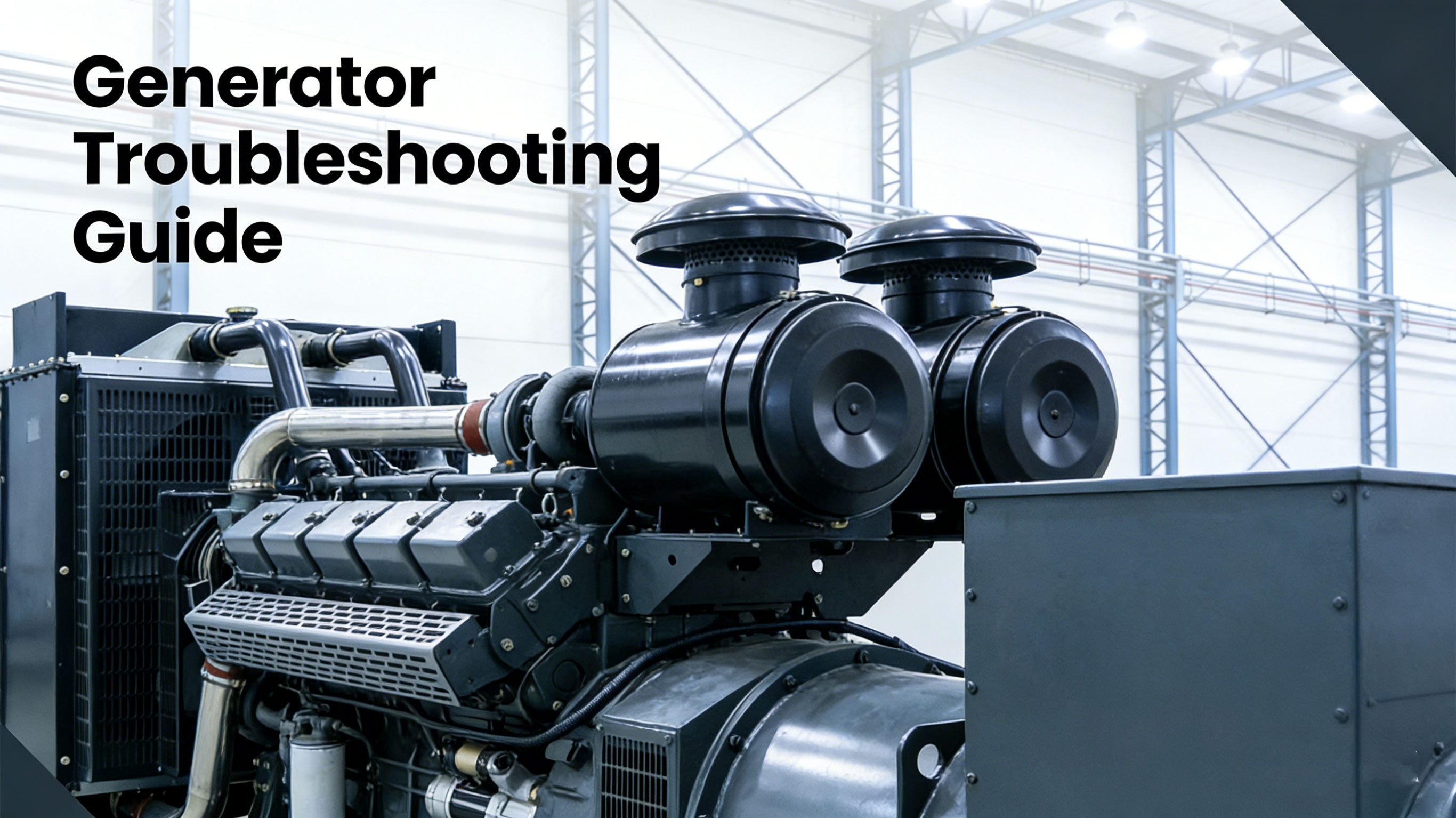
As large-scale precision mechanical equipment, the operating status of generators directly affects the stability of power supply. Since most users are not professional technicians, they may encounter various problems during daily operation. To help everyone efficiently troubleshoot faults and solve problems standardizedly, Chengjian combines the principle of equipment operation and practical experience to detailedly disassemble the common causes of faults and corresponding solutions, as follows:
1. Loose Wire Connections
Causes: Generators operate at high speed for a long time, which will produce continuous vibration. This is likely to cause loosening of terminal blocks and connecting bolts, or oxidation and poor contact of cable joints, resulting in increased circuit contact resistance and unstable current transmission, thereby leading to fluctuations in output voltage. In addition, failure to fasten according to specifications during wiring and improper cable selection (such as too thin wire diameter) may also exacerbate this problem.
Solutions: First, shut down the generator and cut off the main power supply to ensure operational safety; then comprehensively inspect all wiring parts of the generator, focusing on key nodes such as output terminal blocks, cable joints, internal wiring of the control panel, and grounding terminals, to check for loosening, falling off, oxidation, ablation and other phenomena; fasten the loose bolts and terminals, polish and derust the oxidized joints, and replace damaged and aging cables; after the inspection, start the generator for trial operation, observe whether the voltage returns to stability, and ensure that the wiring is firm and the contact is good.
2. Failure of Voltage-Current Selector Switch on Control Panel
Causes: The voltage-current selector switch on the control panel is a key component for switching measurement modes and adjusting circuits. Long-term and frequent operation will cause wear and oxidation of the internal contacts of the switch, or poor contact of the contacts and open circuit of the internal lines of the switch, making it impossible to switch gears normally. This leads to abnormalities in voltage detection and adjustment, which is manifested as unstable output voltage.
Solutions: First, shut down the generator and cut off the power supply, open the control panel cover, and observe whether the selector switch has damage, ablation and other traces; detect the on-off status of each gear of the switch with a multimeter to confirm whether the switch is faulty; if the switch contacts are severely worn and cannot be turned on or switched normally, it is necessary to replace the voltage-current selector switch that is completely matched with the generator model and specifications; after replacement, rewire and fasten, start the generator for commissioning, ensure that the switch switches smoothly, the contact is good, and the voltage display is normal.
3. Failure of Voltage Adjustment Resistor on Control Panel
Causes: The voltage adjustment resistor (also known as the voltage regulating potentiometer) is a core component for controlling the output voltage of the generator. It stabilizes the output voltage by adjusting the resistance value to change the circuit current. During long-term use, the internal resistance wire of the resistor is prone to aging and burning, or the contacts are in poor contact and the adjustment knob is stuck, resulting in the inability to adjust the resistance value normally, which in turn causes the output voltage to be too high, too low or fluctuate greatly.
Solutions: After shutting down the generator and cutting off the power supply, open the control panel, find the voltage adjustment resistor, and observe whether it has ablation, damage, loosening and other conditions; measure the resistance value of the resistor with a multimeter, and compare it with the standard resistance value in the equipment manual to judge whether the resistor is faulty; if the resistor is aging, burned out or adjustment fails, replace it with a voltage regulating resistor consistent with the original model and specifications; after replacement, slowly adjust the knob, observe the change of output voltage until the voltage stabilizes within the standard range, and check that the resistor wiring is firm to avoid poor contact.
4. Voltmeter Failure
Causes: The voltmeter is an intuitive tool for monitoring the output voltage of the generator. If the internal coil of the voltmeter is burned out, the pointer is stuck, or the wiring is loose and the meter head is damaged, the voltmeter display will be inaccurate, which may be misjudged as unstable voltage (the actual voltage may be normal), or the real voltage fluctuation problem cannot be found in time, affecting fault troubleshooting.
Solutions: Shut down the generator and cut off the power supply, check whether the voltmeter wiring is firm, and rule out the display abnormality caused by loose wiring; remove the voltmeter, detect whether the meter head is normal with a multimeter, or replace it with a known good and specification-matched voltmeter for replacement test; if it is confirmed that the original voltmeter is faulty, replace it with a voltmeter matched with the generator voltage range and accuracy, rewire and fasten, ensure that the voltmeter display is accurate and can truly reflect the output voltage of the generator.
5. Poor Voltage Regulator or Unadjusted Voltage Regulator
Causes: The voltage regulator is the core control component for stabilizing the output voltage of the generator, which is responsible for automatically adjusting the excitation current to keep the output voltage within the standard range. If the internal electronic components of the voltage regulator are aging and damaged, or the excitation coil is short-circuited or open-circuited, the voltage regulator will not work normally; in addition, inadequate commissioning of new machines, deviation of voltage regulator parameters after long-term operation, or failure to calibrate the voltage regulator regularly according to equipment requirements will also cause unstable output voltage.
Solutions: After shutting down the generator and cutting off the power supply, first check whether the wiring of the voltage regulator is firm and free of damage, and rule out wiring problems; open the voltage regulator shell, observe whether the internal electronic components have damage phenomena such as ablation, bulging and loosening; measure the output voltage and excitation current of the voltage regulator with a multimeter, compare with the equipment standard parameters, and judge whether the voltage regulator is poor; if the voltage regulator is damaged, replace it with a voltage regulator matched with the generator model; if the voltage regulator is not adjusted or the parameters are deviated, according to the requirements of the equipment manual, slowly adjust the voltage regulating knob of the voltage regulator, combined with the voltmeter display, calibrate the output voltage to the standard range, lock the parameters after commissioning, and calibrate regularly.
6. Excessive Vibration During Generator Operation
Causes: Excessive vibration during generator operation will cause the position of internal components (such as exciter, stator, rotor) to shift and poor contact, and at the same time affect the firmness of the wiring parts, thereby leading to fluctuations in output voltage. Common causes of excessive vibration include: aging and damage of shock absorption equipment (such as deformation and fracture of shock absorption pads), uneven installation of the generator, loose fixing bolts, unbalanced rotor, or excessive wear and clearance of internal bearings.
Solutions: After shutting down the generator, first check the installation status of the generator, confirm whether the installation foundation is level and the fixing bolts are firm, and fasten them in time if they are loose; check the shock absorption equipment (shock absorption pads, shock absorption springs, etc.), check for deformation, aging, fracture and other conditions, replace the damaged shock absorption components to ensure good shock absorption effect; check whether the generator rotor and stator have unbalance, eccentricity and other problems, and perform dynamic balance correction if there is any abnormality; check the wear condition of internal bearings, and replace the bearings in time if they are severely worn and have excessive clearance; after all inspections and adjustments, start the generator for trial operation, observe whether the vibration amplitude is normal and the voltage is stable.
7. Unstable Engine Speed
Causes: The output voltage of the generator is directly related to the engine speed (stable speed can ensure stable voltage). If the engine speed is fluctuating, it will cause the generator rotor speed to fluctuate, thereby leading to unstable output voltage. The main causes of unstable engine speed include: fuel system faults (such as blocked fuel filter, worn fuel injector, insufficient fuel pump pressure), blocked air filter, abnormal ignition system, governor failure, or poor fuel quality and oil circuit leakage.
Solutions: First check the fuel system, clean the impurities in the fuel filter and oil circuit, and replace the blocked filter; check whether the fuel injector is worn or blocked, and clean or replace it; detect the fuel pump pressure to ensure that the pressure meets the standard, check whether there is leakage in the oil circuit, and repair it in time; clean the air filter to ensure smooth air intake; check the ignition system (such as spark plug, ignition coil), and replace aging and damaged components; check the working status of the governor, and adjust or replace it if the governor fails; add high-quality fuel that meets the equipment requirements, and avoid using fuel with excessive impurities and inconsistent labels; after adjusting or replacing relevant components, start the engine, observe whether the speed is stable, and then confirm whether the output voltage returns to normal.
Warm Reminder: As large-scale precision equipment, generators must strictly abide by safe operation specifications during fault troubleshooting and maintenance. Prioritize shutting down the generator and cutting off the power supply to avoid risks such as electric shock and mechanical injury; if encountering complex faults (such as internal winding damage, excitation system faults), it is recommended to contact professional technicians for handling, and do not operate blindly to avoid damaging the equipment or causing safety accidents.



 English
 Chinese
 French
 German
 Russian
 Italy
Italy Spain
Spain Portugal
 Japanese
 Korean
 Arabic
 Traditional